Building Enterprise Value
Strategic guidance, accounting clarity, governance frameworks, and operational insights for growth-stage companies, public issuers, and investors.
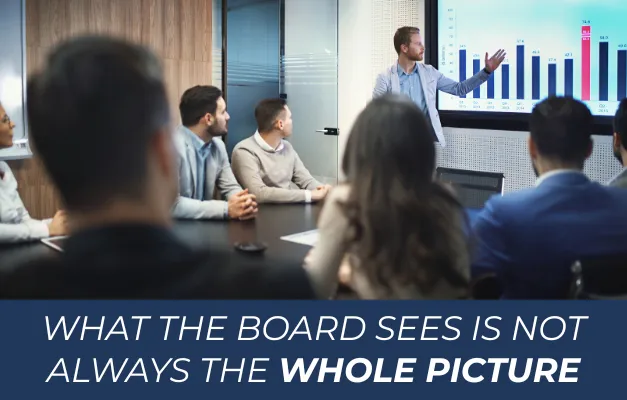
What the Board Sees Is Not Always the Whole Picture
What if every report in front of the board is accurate, and the board still does not have the full picture?
The financials say the company is on plan. The risk register is current. Operations are meeting their targets. Technology reports that the systems are running normally.
Nothing appears to require immediate attention.
And yet, a key team may be stretched beyond capacity. A new risk may have emerged between reporting cycles. A critical process may depend on one person whose knowledge has never been documented.
None of these things necessarily appears in the reports.
That is the challenge for directors. The information reaching the board may be accurate while still leaving important parts of the organization out of view.
The Distance Between the Organization and the Boardroom
Every organization has layers between the operating level and the boardroom. Information is gathered, interpreted, summarized, and presented. By the time it reaches directors, it has usually passed through several people and processes.
That is how organizations function. Directors cannot, and should not, be involved in every operational detail.
But distance creates a governance challenge. The board needs enough visibility to distinguish between a business that is genuinely under control and one that simply appears to be.
A Changing Reporting Environment
That question is becoming more relevant as some of the traditional checkpoints around financial reporting are being reconsidered.
In May, the SEC proposed allowing public companies to file semiannual reports on a new Form 10-S instead of quarterly Form 10-Q reports. The proposal is not final, but it would give eligible companies greater flexibility over the frequency of their interim reporting.
The PCAOB is also continuing to engage directly with audit committees. In April, it published findings from conversations with more than 250 audit committee chairs, covering their perspectives on areas including fraud risk, technology, internal controls, and communication with auditors.
The direction of these changes matters, but the underlying issue is broader than reporting frequency. Whether information reaches the board quarterly, semiannually, or through another reporting process, directors still need to understand what may sit outside the view they are being given.
Information Is Not the Same as Visibility
A board can receive extensive reporting and still have blind spots.
Financial results may show performance is on plan while operational pressures quietly build. A risk register may be current while a new risk develops faster than the reporting cycle can capture it. A technology report may confirm that systems are functioning while the organization becomes dependent on processes only a few people understand.
None of these situations necessarily means something is wrong. They illustrate a simpler point: every report is a view of the organization, not the organization itself.
What Can Directors Do Today?
Rather than simply asking for more information, directors can ask where their current information may be incomplete.
A few questions worth putting on the table:
What are we not seeing?
Where is management's own visibility limited?
Which information do we rely on most heavily, and how has it been challenged?
Where are we dependent on one person, system, or process?
If something changed quickly, how would we know?
Who can give us an independent view when we need one?
That last question matters because an independent perspective does not assume management is wrong.
It can test what has been reported, connect information from different parts of the organization, or raise a question nobody has thought to ask. Sometimes the conclusion is reassuring: the controls work, the processes are sound, and the board can rely on what it has been told. That reassurance has value too.
The board cannot see every process, conversation, or decision inside an organization. It has to rely on management, and that reliance is reasonable.
But good oversight also means knowing where that reliance may leave gaps.The question is not whether the board has enough information. It is whether the board has enough visibility to know what that information is actually telling it.