
Blog
Building Enterprise Value Through Strategic Financial & Operational Advisory
Why Tighter Controls Are the Engine of Scalable Growth
A team lead starts approving purchases that used to go through finance. A revenue number gets booked slightly differently than last quarter because the person who handled it before left. A forecast gets built in three different spreadsheets by three different people, and no one's quite sure which version leadership is looking at.
Each of these seems manageable. Add them together, and you've got a business that's grown faster than its ability to see what's actually happening inside it. That's not a scale problem. That's a controls problem that scaling made visible.
What scaling actually exposes
When businesses are small, judgment fills the gaps. A founder knows the bank balance. A single controller touches every transaction. Decisions happen in a room with the same three people.
As volume increases, that model breaks. A hundred transactions a week becomes a thousand. One sales team becomes five. Spending decisions that one person used to make are now happening across multiple departments, or without any approval chain at all.
The controls that worked at $5M don't hold at $25M. Not because they were bad, but because they were built for a business that no longer exists.
The signals worth paying attention to
If your business is growing and any of these feel familiar, the issue isn't pace, it's structure.
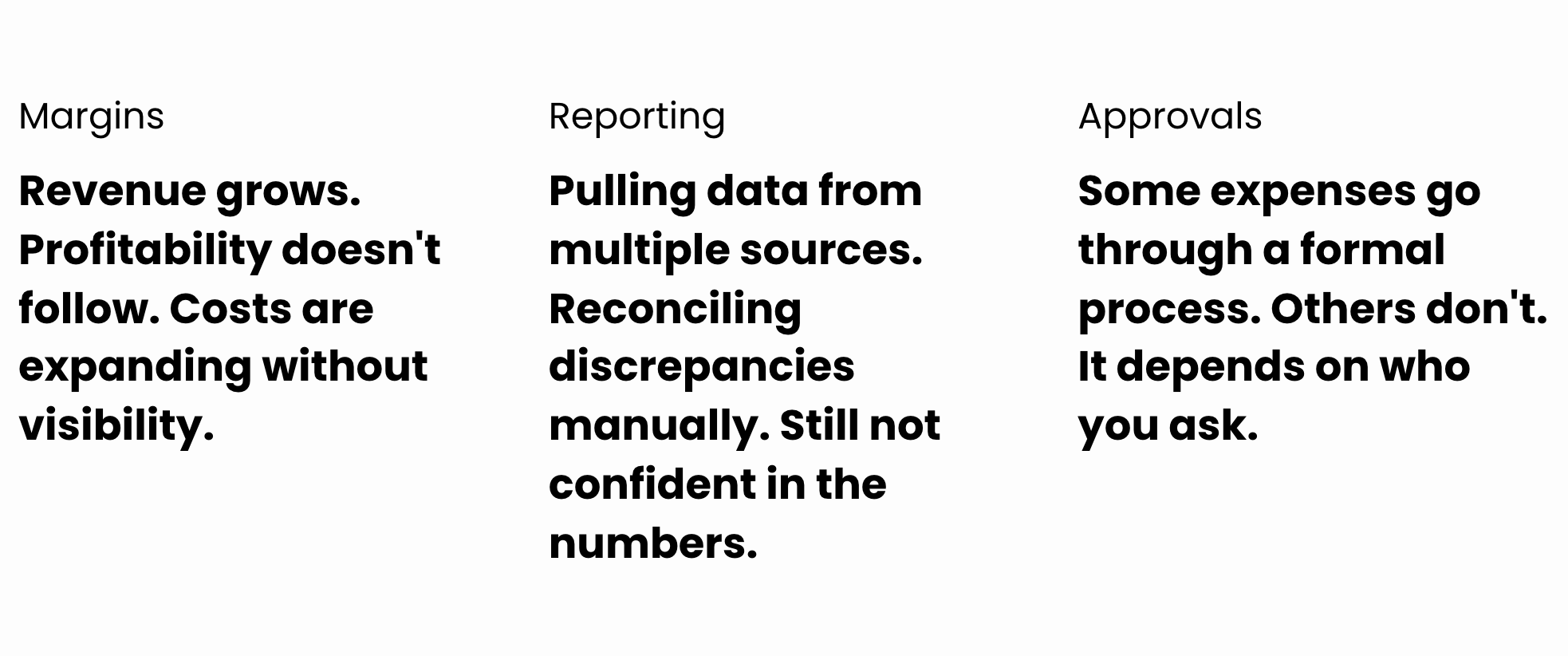
None of this looks catastrophic in isolation. But together, these are the early signs that your controls haven't grown with your business.
Controls are not the opposite of speed
The instinct in fast-growing companies is to keep structure light. Move fast. Don't let process get in the way of momentum.
That instinct is right up to a point. Past it, the absence of structure doesn't produce speed. It produces noise. Leaders spend more time chasing information than acting on it. Finance spends more time explaining variances than analyzing them.
Tightening controls at scale isn't about slowing down. It's about making sure that as volume increases, the organization can still see clearly, move with confidence, and trust the numbers it's running on.
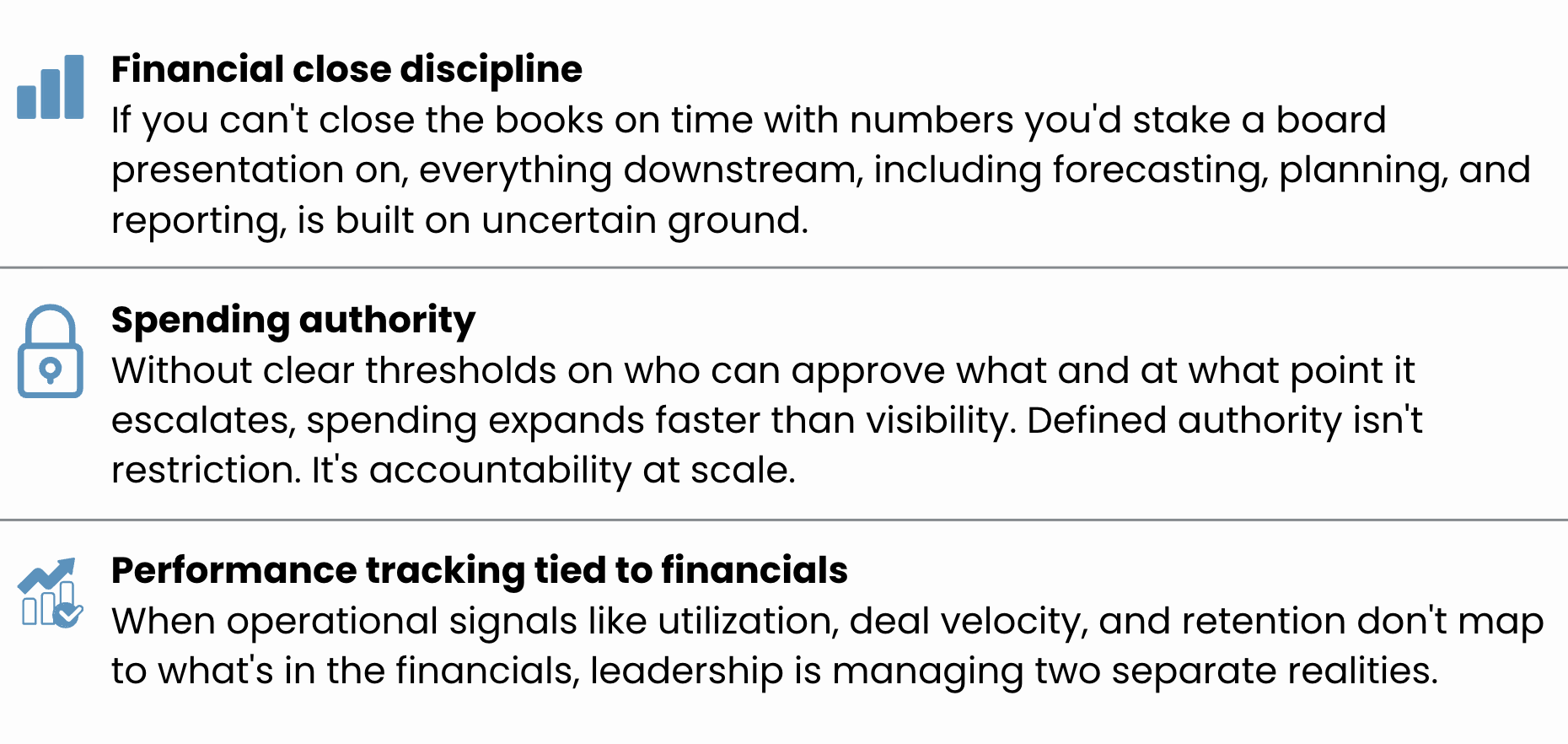
Three areas where that work pays off fastest
The question worth asking now
Not "do we have controls," but "have our controls kept pace with where we actually are?"
Most growing companies discover the answer to that question under pressure — during a fundraise, an acquisition process, or an audit — when the cost of the gap is highest. The ones that don't are the ones that asked it before they had to.
If your business has grown significantly in the last 18 to 24 months, the honest answer probably involves some gaps. That's normal. What matters is whether you know where they are and have a plan to close them before they close you.


Copyright 2022 - RNB Capital LLC - All Rights Reserved